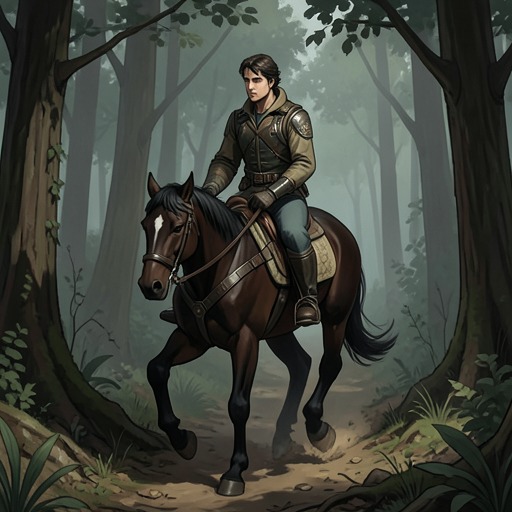
Aslan appears to Shasta and reveals his guidance along the way
The Horse and His BoyAslan appears to Shasta during a lonely night ride and reveals that he has been present throughout the boy’s journey. What Shasta has understood as a string of separate misfortunes and dangerous lion encounters is recast as a connected course of intervention: Aslan has brought Shasta together with Aravis, protected him on the road, and helped him reach King Lune in time. The revelation changes the meaning of the journey without making every hardship easy to understand; when Shasta asks why Aravis was wounded, Aslan tells him that he is hearing Shasta’s story, not hers.
The Encounter in the Darkness
Shasta is tired, hungry, and convinced that everyone else has fared better. The Narnian nobles have escaped Tashbaan; Aravis, Bree, and Hwin have found shelter with the Hermit; and Shasta believes King Lune and his people will be safe behind the gates of the castle. He feels left behind and weeps as he continues toward them. The scene turns when he gradually notices a breathing presence walking beside him in the dark. He cannot see it, and the scale of its breath makes him imagine a giant. When it speaks, Shasta asks whether it is a ghost and pleads for it to go away.
The companion does not begin by naming itself. It says it has waited a long time for Shasta to speak, then asks him to tell his sorrows. Reassured that the warm breath is not that of a ghost, Shasta recounts his unknown parents and stern upbringing by the fisherman; his escape; the dangers of the journey; the night among the tombs; the desert heat and thirst; Aravis’s injury; and his lack of food. His account is the limited, personal inventory of a boy who can see the ordeals but not yet their pattern.
The One Lion and the Road’s Hidden Pattern
When Shasta asks whether it was bad luck to meet so many lions, the Voice corrects his account: there was only one lion, swift enough to seem like several. It identifies itself as that lion and connects separate episodes Shasta had experienced as unrelated. It was the lion that forced him to join Aravis, the cat that comforted him among the tombs, and the lion that drove jackals away while he slept. It also gave the horses a last surge of fearful strength so they could reach King Lune in time. Finally, it reveals that it had pushed the boat carrying Shasta as a near-dead child toward the shore, where a man was awake to receive him.
The disclosure does not erase danger from the story; it changes who has been acting within it. The companions’ meeting, the protection at the tombs, the horses’ final effort, and Shasta’s arrival at the shore become parts of a single history of Aslan’s guidance. The boy had called himself unfortunate because he judged each episode from within its immediate fear. Aslan’s account supplies a wider continuity, reaching back to Shasta’s infancy and forward to the urgent arrival at King Lune.
What Aslan Reveals—and Withholds
Shasta asks whether Aslan was also the lion who wounded Aravis. Aslan confirms that he was, but declines to explain the matter to Shasta: he is telling Shasta his story, not hers, and tells no one any story but his own. This boundary makes the revelation deliberately incomplete. Shasta is given the meaning of the interventions that shaped his own path, but not authority over another person’s experience. The book later supplies the reason in Aslan’s conversation with Aravis: the harm she had caused by drugging her stepmother’s enslaved attendant was answered by an equivalent experience for Aravis. That explanation belongs to Aravis’s encounter with Aslan, rather than to Shasta’s account of his own.
The scene therefore joins providential guidance to a limit on knowledge. Aslan makes the hidden pattern visible, yet does not turn one person’s disclosure into a complete explanation of everyone else’s suffering. His answer redirects Shasta from comparing his lot with other people’s to receiving the story that concerns him.
Recognition at Daybreak
While Shasta speaks with the unseen companion, the night mist changes from black to gray and then to white. As daylight grows, birds sing and Shasta can see the horse beside him. A golden light comes from the left; when he turns, he sees a lion pacing beside the horse, taller than it. The horse does not seem afraid, while Shasta recognizes the gravity of the presence. Though he knows none of the true stories about Aslan, he understands the lion’s identity from its face, slips from the saddle, and falls at its feet.
Aslan stoops and touches Shasta’s forehead with his tongue. Their eyes meet, and the pale brightness of the mist and the lion’s fiery brightness gather into a swirling glory and disappear. Shasta is left with the horse on a grassy hillside beneath a blue sky, with birds singing. The meeting moves from a voice that Shasta cannot locate, through a verbal disclosure that reorganizes his past, to a brief visible recognition and departure. Daybreak makes that change legible: the journey continues, but Shasta no longer understands himself as abandoned to a run of unrelated bad luck.